Wednesday, June 19, 2013

Free Improvisation Series: Stuff Smith & Robert Crum (part one)


Well, it's been a while since I've posted an update. I've been hard at work, finishing a master's degree, planning various recording projects, and a whole mess of other business. Here's a two-part attempt at a more complete picture of Robert Crum, a boogie-woogie pianist.

Robert Crum (Nov. 29th, 1915 – May 1981) was born in Pittsburgh, PA. He studied classical piano there, as well as in Paris. In the 1930's lived in Chicago, IL where he took lessons from Meade Lux Lewis1 and began playing at small clubs, where he made about $35 a week.2 By January 1943 he was working as the afternoon pianist at Elmer's Cocktail Lounge, where Dorothy Donegan had also recently worked.3

Advertisement for the Hotel Sherman, ca. 1945
In July of that year he was hired to play at the Sherman Hotel's Panther Room for $300 per week.4 The Panther Room, along with the Malaya Room, formed the Hotel's College Inn restaurant, which served extravagant meals served on flaming swords by stereotyped waiters, and featured the day's top entertainment. The College Inn started booking swing music in March 1939; by that same time in 1942 they had booked major acts like Gene Krupa, Benny Goodman, Fats Waller, Harry James, Jimmy Dorsey, and Woody Herman, often for repeat stints.5 As a major focal point in the Chicago music scene, the Sherman Hotel's entertainment was watched closely by the entertainment press. Crum was booked as the Panther Room's afternoon entertainment, and was reviewed often by writers for The Billboard magazine. A typical example is a review which appeared in August 1944, which noted that Crum had “fine keyboard work. It is mostly straight pounding, with little visual showmanship. Crum keeps close to the keyboard, seldom lifting his head to see if anyone is paying attention. Goes over, tho.”6

His playing went over very well, apparently. In September, Crum was given a pay raise to $400 per week.7 In January 1944, the Billboard reported that Crum, perhaps to increase his visual showmanship, was employing a long mirror on several pieces so that members of the audience would be able to see his hands as he played. This prompted Billboard's Carl Cons to comment that although Crum's “finger dexterity is excellent and very commercial … his playing at times leaves music lovers in a fog.” He continued,

“Neither a concert artist nor a good swing pianist, his semi-classical style of presenting numbers is often spoiled by corny tricks such as running his thumb across the keys and playing with the back of his hands. Has talent and could improve his performance by adding taste to his arrangements and eliminating some of the gingerbread that passes for showmanship.”8

In November 1943 Crum apparently had plans to move to New York in January 1944, following his stint at the Panther Room,9 but he decided to stay in Chicago for a few more months. In February 1944 he appeared in a variety show at the Chicago Theater, with singer Phil Regan as the headliner. Billed as “The Swing Piano Sensation of the Nation”, Crum was given a favorable review by Jack Baker, who wrote that,

“[Crum] shows remarkable skill with his rapid piano keying, and swings out in a fast tempo on the classical and pop tunes. Distinctly different, and draws plenty of mitting with his fine arrangements of Massanet's Elegy, boogie-woogie medleys and Humoresque, which is interspersed with a smart concert arrangement of Rhapsody in Blue.”10

New York City skyline, ca. 1940
Perhaps encouraged by the positive press and high-profile work, Crum made the move to New York City in April 1944.11 In May he appeared on the Basin Street radio program alongside pianists Francis Carter, Arthur Bowie (who played as the duo Carter & Bowie) and Art Tatum.12 In June, Paul Ross mentioned Crum in a long list called The Top Names, “prize winners in the jazz joints of 52d Street”, which included Tatum, Mary Lou Williams, Earl Hines, Duke Ellington, the Nat King Cole Trio, Roy Eldridge, Billie Holiday, Oscar Pettiford, and a host of other major names.

The article, entitled “Disks a Must for 52d Street Click” and subtitled “Musicianship Essential But Waxing Required, Too”, reports that 25-50% of club clientele are tourists, and that “by far the largest part of this group of customers comprises young people who read the hip magazines and who, above all, listen to phonograph records. They are disk educated to a high degree.” Ross concludes that “when they hit New York and are entertainment bound, they are always ready to go and hear – in person – the man or woman who turned out this or that big disk.” He continues by mentioning that another 25% of club clientele are musicians themselves. And nobody is more critical of musicians than other musicians.” This significant sector of club clientele, Ross says, helps keep novelty artists, “the trickster [and] the corn-dispenser” from dominating the bandstands.
One would not be amiss to question Ross' figures (did he conduct a survey?), but his overall point is rather plausible. Therefore it's rather puzzling that Crum would be included as a “Top Name”. He had only lived in New York City for two months at the time, had no recordings to his name, and did not have any work as a sideman. And less than a year prior, Crum had been criticized in the same magazine for his “gingerbread” showmanship. Ross adds that “an act without even one big record behind it can work in the jazz bistros and do all right, providing it has musicianship. If the turn gets by the other musicians it can build in anywhere from six months to a year – build to the point where it begins making disks and thus enhances its [box office] value. But the old musicianship must be there or no dice.”13

Ross' article appeared shortly before RCA/Victor and Columbia had conceded to the demands of the American Federation of Musicians, which was still on strike.14 There was also a major shortage of domestic shellac, imposed by the War Production Board, causing a drop in disk production.15 It was a time of great upheaval and change in the recording business, and breaking into the recording medium was likely to prove difficult for a relative newcomer like Crum.

A typical logo for The Billboard magazine
As a side note, it's worth remembering that the entertainment press's goal (in 1944, but it's not much better today) was not to document the change of musical styles and the artistic growth of its individual practitioners. This is just a historical side-effect. As a trade periodical, the Billboard's goal was to keep booking agents, business owners, and advertisers apprised of the goings-on in the major entertainment centers. The artistic goals of musicians were of far lesser concern to critics than was the musicians' level of business acumen. But we should not make the mistake of thinking that the musicians written about in these magazines were as single-minded as the articles may portray them. We take for granted that Fats Waller, Gene Krupa, Woody Herman and all of the acts booked at the Sherman Hotel were not just major entertainers but also major artists. There is no inherent inconsistency here, but we must avoid the temptation to think that more marginal musicians simply lacked this vision, and are therefore not worthy of study or consideration. The activities that make Crum especially notable today are coming up in part 2 of this blog post.


Footnotes

1 Barnett, 2002, "Complete 1944 Rosenkrantz Apartment Transcription Duets", ABFable CD 004/005.
2 The Billboard, “Shelley Signs Bob Crum, Chi Pianist”. August 21st, 1943, p. 24
3 The Billboard, “Off the Cuff”. January 30th, 1943, p. 19
4 The Billboard, “Open Field For Graduates”. July 17th, 1943, p. 20
5 The Billboard, “Chi's Sherman Room Still Swings It”, March 28th, 1942, p. 6
6 The Billboard, “Follow-Up Night Club Review”. August 28th, 1943, p. 21
7 The Billboard, “Ivory Pounders in Chips”. October 2nd, 1943, p. 24
8 The Billboard, “Night Club Reviews”. January 22nd, 1944, p. 25
9 The Billboard, “Off the Cuff”. November 6th, 1943, p. 23
10 The Billboard, “Vaudeville Reviews”. February 26th, 1944, p. 22
11 The Billboard, “Chicago Air Execs Scouting Lounges for Talent 'Finds'”. April 15th, 1944, p. 20
12 The Billboard, “Top Radio Stanzas Finding Place for Small-Club Acts”. May 27th, 1944, p. 28
13 The Billboard, “Disks a Must for 52d Street Click”. June 24th, 1944, pp. 23 & 27
14 The AFM had been on a no-recording strike since August 1st, 1942 with the demand that recording labels pay a fee to license recordings for radio and jukebox play. This fee would be added to the AFM's Recording and Transcription Fund (RTF), which the AFM would use to offer work to underemployed musicians. Most smaller labels had capitulated by this time, but RCA/Victor and Columbia, the two largest, would not do so until November 1944.
15 See, for example, “Diskers Eye WPB Action”, (Billboard 6/27/42, p. 70) and “Financial Journal Features News Of Shellac Situation and Prices”, (Billboard, 10/31/42, p. 62)

Monday, August 6, 2012

Improvised Music Before 1970: An Incomplete Discography

Roy Eldridge was interviewed by Barry Ulanov for his 1952 book History of Jazz In America. Ulanov had lately been advocating for Lennie Tristano's experiments in improvisation, so he asked Eldridge what he thought of the idea. Eldridge described a session with pianist Clyde Hart: 
  
"Clyde Hart and I made a record like that once. We decided in front that there'd be no regular chords, we'd announce no keys, stick to no progressions. Only once I fell into a minor key; the rest was free, just blowing. And, man, it felt good." (p. 239) 

Eldridge's only known recordings with Hart happened between 1938 and 1940. They recorded together in Chu Berry's band in 1938, and with Fred Rich in 1940. And Eldridge hired Hart for a stint at the Arcadia Ballroom in 1939.

Perhaps the recording has been released. But I have not found it listed in any discography. If it was in fact recorded, there's the possibility that it was never released. If that's the case, the master was either discarded or it was put into storage.

I am, rather loosely, defining free improvisation as any music within which, as a matter of principle, the musician has complete freedom to do whatever he/she wishes. This presupposes that there is no composition whose directions are being followed: not a motive, not a graphic score, not a mode or scale, not a riff, and no conduction.

These criteria are probably too strict. But that's what I'm working with here. If you have suggestions for how to make this list better, please post a comment below. 

Additions have been made for the following artists:
The People Band (added Aug 2021)
The Fourth Stream (added Feb 2021)
Art Ensemble Of Chicago (added Sept 2020)
Clare Fischer (added May 2017)
Charlie Nothing
Malachi
Gruppo Romano Free Jazz
Mario Schiano
Chico Hamilton Quintet
Paul Horn

July 2020 - I took out the Paul Horn entry... The title track sounds like it's free, but then the band comes in. Chico is first, with a Charleston figure on brushes - then when Fred (cello) and Gerry (Wiggins, piano) enter, they seem to know exactly what to do harmonically and rhythmically. It's probably a very loosely composed piece or head chart, in sort of the way that Flamenco Sketches is - not exactly a "tune" but also not exactly a free improvisation.

 Improvised Music Before 1970 - An Incomplete Discography

A

AMM, “AMMMusic”, Elektra, 1966
AMM / Musica Elettronica Viva, “Live Electronic Music Improvised”. Mainstream Records, 1970
AMM, “The Crypt – 12th, June, 1968”. Matchless Recordings, 1978
Amon Düül, "Psychedelic Underground"
Amon Düül, "Collapsing"
Amon Düül, "Disaster"
Art Ensemble of Chicago, "People In Sorrow", Pathé, Nessa, 1969

C

Charles Ives, “Ives Plays Ives – The Complete Recordings of Charles Ives at the Piano, 1933-1943”. Composers Recordings, Inc. [Two, maybe three tracks improvised.]
Charlie Nothing, "The Psychedelic Saxophone of Charlie Nothing". Takoma Records, 1967.
Charlie Nothing, "Outside/Inside". De Stijl Records, 2011 [recorded in 1969]. 

Chico Hamilton Quintet
, "s/t". Pacific Jazz, 1955. One track ('Free Form') fully improvised. They get into a i ii(halfdim) iii ii pattern for a while but I'm pretty sure 
Columbia Symphony Orchestra, “Lukas Foss: Time Cycle”. Columbia, 1962 [Featuring improvised interludes by Foss' Improvisation Chamber Ensemble.]
Clare Fischer, "First Time Out". Pacific Jazz, 1962. One track ('Free Too Long') sounds fully improvised.

D

Django Reinhardt, "In Solitaire". Definitive, 2005 [recorded between 1937-1950]

E

Erroll Garner, “Overture to Dawn, vol. 1”. Blue Note, 195? [recorded in 1944]
Erroll Garner, “Overture to Dawn, vol. 2”. Blue Note, 195? [recorded in 1944]
Erroll Garner, “Afternoon of an Elf”, Mercury, 1955. [One track improvised.]

F

The Fourth Stream, "White Field". Pioneer, 1968 [recorded in 1967]
Free Form Improvisation Ensemble, “The Free Form Improvisation Ensemble”. Cadence, 1998 [recorded in 1964]

G

Georges I. Gurdjieff, “Harmonic Development”. Basta, 2005 [recorded in 1948-49]
Group Ongaku, “Music by Group Ongaku” Seer Sound Archive, released in 1996/2011, recorded in 1960.
Gruppo Improvvisazione Nuova Consonanza, “The Private Sea of Dreams” [US title]. RCA Victor, 1967.
Gruppo Improvvisazione Nuova Consonanza, “Improvisationen”. Deutsche Grammophon, 1968.
Gruppo Improvvisazione Nuova Consonanza, “The Feed-back”. RCA Italiana, 1970.
Gruppo Improvvisazione Nuova Consonanza, “1967-1975”. Edition RZ, 1992.
Gruppo Improvvisazione Nuova Consonanza, “Azioni”. Die Schachtel, 2006.
Gruppo Romano Free Jazz, "1966-67". Vedette, 1977. [recorded in 1967]

H

Hapshash and the Coloured Coat, "Featuring the Human Host and the Heavy Metal Kids". Liberty, 1967.

J

Jean Dubuffet & Asger Jorn, “Musique Phénoménale”. 4 10''-record set, 50 copies, Edizione del Cavallino, 1961.
Jean Dubuffet, “Experiences Musicales”. Finnadar, 1973.

L

Lennie Tristano, “Crosscurrents”. Capitol Records, 1972. [Contains Intuition and Digression, recorded in 1949]

M

Malachi, "Holy Music". Verve Records, 1966. [Richard Barthelme from the Red Krayola plays on a couple tracks]
Mario Schiano, "Original Sins 1967/70 Unreleased". Splasc(h), 1992. [recorded between 1967 and 1970]
Musica Elettronica Viva, “Friday”. Polydor, 1969.
Musica Elettronica Viva, “The Sound Pool”. Actuel, 1970.
Musica Elettronica Viva, “The Original”. IRML, 1996.
Musica Elettronica Viva, “Rome Cansrt”. IRML, 1999.
Musica Elettronica Viva, “Spacecraft / Unified Patchwork Theory”. Alga Marghen, 2001. [disc 1 recorded in 1967.]
Musica Elettronica Viva, “Pieces”. IRML, 2004. [recorded in 1966/67]
Musica Elettronica Viva, “MEV 40”. New World Records, 2008. [disc 1 recorded in 1967]

N

New Music Ensemble, “Improvisations”. New Music Ensemble, 1963.
New Music Ensemble, “New Music Ensemble II”. New Music Ensemble, 1964.
Nihilist Spasm Band, “The Sweetest Country This Side of Heaven”. Arts Canada, 1967.
Nihilist Spasm Band, “No Record”. Allied Record Corporation, 1968.

P

The People Band, “The People Band". Transatlantic, 1970. [recorded in 1968]

R

The Red Crayola & the Familiar Ugly, “Parable of Arable Land”. International Artists, 1967. [Free-form Freak-out tracks are improvised, also the title track. Mayo Thompson, Fred Barthelme and Steve Cunningham.]
The Red Krayola, “God Bless the Red Krayola and All Who Sail With It”. International Artists, 1968. (2, maybe 3 tracks improvised)
The Red Crayola, “Live 1967”. Drag City, 1998. [recorded in 1967]
The Red Krayola, “Coconut Hotel”. Drag City, 2005. [recorded in 1967]
Roy Eldridge & Clyde Hart, unknown title, unissued? 1939?

S

Stuff Smith & Robert Crum, “The 1944 Rosenkrantz Apartment Transcriptions”. AB Fable, 2002.
Stuff Smith, “1944–1946 Studio, Broadcast, Concert & Apartment Performances”. AB Fable, 2002.

T

Tangerine Dream, "Electronic Meditation"

Wednesday, August 1, 2012

Notes on Freeform Radio

This short essay was written in 2011 when I started my blog for my show on WCBN called Doomsday Radio. It's a concise summary of my theoretical approach to freeform radio. As such, the issues it raises need expansion, which I will provide sometime. For the time being, this suffices.

Notes on Freeform Radio

Record albums foster content- and object-based community, through the distribution and sale of plastic objects with sound encoded into them. When you listen to the radio, there are likely (at least) dozens of other people who are listening to the exact same thing, at the same time. In other words, radio fosters content- and time-based community (i.e. when you and your friend listened to the same radio show at the same time of the day). Another way of saying this is that a sound recording preserves neither space nor time of the event that it documents; radio preserves time but does not preserve the space of the event.

Despite the common joke that radio is a "dying medium", radios are ubiquitous: far cheaper than a CD player or an iPod, included in all cars, and many alarm clocks. This implies wide and easy access in our society, lending to its ability to foster a time- and content-based community. Indeed, a recent Nielsen poll has found that 56% of teenagers listen to music on the radio, and 48% of the new music people hear is first heard over the radio.

Commercial radio expresses the desires and interests of advertisers and the rather unadventurous producers who are responsible for assembling the songs we hear. Advertising dollars run commercial radio; the songs are filler in between the content: advertisements.

Freeform radio expresses the desires and interests of the individual DJ, him/herself a member of the community. The DJ's interests are filtered (though very slightly) through the interests of institutions like the FCC, and in my case, the University of Michigan.

Freeform Radio is a performance art for an unidentifiable, uncountable audience.

The radio DJ has a responsibility to his immediate community, and also to whoever may be listening via an online stream. This responsibility differs depending on the DJ's style. The freeform DJ's responsibility is not to dull the senses; not to entertain; not to provoke; not to agitate; not to teach. The responsibility of the freeform DJ is to learn. If his/her audience also learns something, so much the better.

The freeform DJ plays songs like a jazz musician improvises, or like a classical pianist plays a Bach Invention: with deliberation, curiosity, humor, honesty, and taste (however tasteless). Songs are selected by direct choice, through association with another recording, or completely at random. Continuity between songs is interesting, but may not be consciously pursued. Continuity emergent from deliberate contrast is a powerful experience. Serendipity is the lifeblood of freeform. A good freeform radio show will teach everyone who hears it: the DJ and the listener alike.

Last updated: October 9, 2019
Previous update: August 27th, 2012

Friday, July 20, 2012

Free Improvisation Series: Erroll Garner


Pianist Erroll Garner (June 15, 1921 – Jan. 2, 1977) is well-known for his dexterous piano playing and creative interpretations of standards. He is the author of the jazz standards “Gaslight” and “Misty”, and is also the first jazz pianist known to have recorded free-form improvisations.

Garner grew up in Pittsburgh, PA where he played solo piano on riverboats, silent movie theaters, and organ at churches. From 1938-1941 he played with the Leroy Brown Orchestra. In 1944, when Garner was 23 years old, he moved from Pittsburgh to New York City and found steady work on 52nd Street.1 While working as the intermission pianist at Tondaleyo's, he attracted the notice of Timme Rosenkrantz, a Danish baron who had been living in New York City since 1936. Rosenkrantz founded the Danish journal Jazzrevy (Jazz Review), becoming the first European journalist to write about Harlem jazz. Rosenkrantz also made forays into radio, hosting Rhythm is my Business on WNEW in 1944. He also operated the Mel-O-Dee Music Shop from 1940-1941. His involvement in the jazz community gained him respect from Louis Armstrong, Duke Ellington, and other major figures.

Rosenkrantz with Louis Armstrong. Photo credit unknown.
In his memoirs, Rosenkrantz wrote that “quite often, after the clubs closed, musicians would come to my place and jam until sunrise. A lot of wonderful music was played and recorded in that old brownstone...”2 Trumpeter Bobby Pratt remembers these afternoon sessions:

“[Rosenkrantz] used to invite musicians over to his house [an apartment at 7 West 46th Street in New York]3 … He had a lot of very good musicians. And at the same time he would be recording these sessions that we had. And Stuff Smith always used to be there. And Bill Coleman, Al Hall, Erroll Garner was there quite a bit, Lucky Thompson, and George Wettling, and Barney Bigard … we used to do those things every Saturday for quite a while … I made quite a few sessions. And it was a lot of fun.”4

Rosenkrantz made dozens of recordings of these jam sessions with his home record cutter, in the mid-1940's. In addition to the musicians mentioned by Pratt, Stuff Smith, Don Byas, Billy Taylor, Thelonious Monk, Willie “The Lion” Smith, and Duke Ellington can also be heard on these recordings. Between October and December 1944, Garner recorded many pieces, mostly solo, including jazz standards like “I Hear A Rhapsody”, “I Got Rhythm” and “Yesterdays”.5 Not limited to three-and-a-half minutes, and not needing to “play the room” (a colloquial phrase for crowd-pleasing), Garner completely reconstructs these pieces in elaborate (and occassionally experimental) fantasias. Take for instance the musical passage beginning around 4:10 on “I Got Rhythm”: Garner leaves the form behind to develop a whole-tone motive over an altered F7 chord, returning to the form at 4:40. The section does not fit neatly into 4- or 8- bar phrases, and seems briefly to take on a life of its own.

During these sessions, Garner also recorded several pieces which were completely improvised. These pieces are generally quite long, and use many of the same formal techniques which Garner used when interpreting the standards and original tunes, except that there are no prefabricated themes to which Garner is bound; he makes them up on the spot, and is free to leave them when he wishes. Because of Garner's penchant for coming up with strong melodies, the free improvisations are at times not easily distinguishable from his original compositions. Indeed, at least one of the themes from the improvisations would later be “solidified” into the tune “Gaslight”. Because he did not read music, Garner used these recordings as a way of documenting his ideas, and played many of them as fully-formed jazz tunes at an important concert at Times Hall on December 20th, 1944.6 There will be much more about this concert in my next post.

The fact remains that Garner improvised many of the pieces on the Rosenkrantz recordings, nearly from scratch. And while Garner's improvisations do not ever really embrace the new tonal explorations of 20th century composers like Leo Ornstein, Anton Webern, or Igor Stravinsky,7 but this does not mean that Garner was using improvisation as a parlor trick to entertain the audience. It is just as likely that Garner simply did not like that kind of music, and so saw no reason to incorporate it into his playing style. Many of the recordings from the Rosenkrantz sessions were released by Blue Note in the early 1950’s as the five-volume Overture to Dawn. They featured liner notes by Leonard Feather, who described the improvised pieces:
The cover to Volume 1 of Overture to Dawn, Blue Note LP 500
“Night after night [Garner] came back [to the Rosenkrantz apartment], playing long, rambling ad lib concertos. On these discs they have titles […] but in fact they were being composed while they were played, and the next morning Erroll could not have repeated any of them. They had no titles, no set form, yet they have a greater variety and continuity of mood, a truer ring of artistry, than almost any of the commercially recorded sides of later years … Here is a man sitting down at a piano and, to all intents and purposes, playing to and for himself; quietly, contemplatively and with a serene beauty.”8

Within a year, Garner was featured on a radio program called the Twelve Eighty Club, where he was asked by the host to improvise a piece on the spot, called the “Twelve Eighty Club Blues”. Garner then plays a 32-bar piece which appears to have been completely improvised. Although the radio host is clearly putting him to the test, Garner is doing more than just a parlor trick. Putting a free improvisation into the container of a 32-bar popular song form poses a very different mental/musical challenge than interpreting a pre-composed tune, even as liberally as Garner does.

There is one interesting exception to either the pre-composed and the free improvised piece. Later on in the Twelve Eighty Club show, Garner states that he will play an excerpt of a “kind of a concerto” which he had written. The program's host suggests the Garner play the whole thing later in the show, and Garner responds that he “can't recollect the whole thing”, but that he calls it “The Mood”. The host suggests that Garner call it the “Forgotten Concerto”, and this is the title given to the piece on the 2002 CD release.9 The Rosenkrantz recordings contain a piece called “Erroll's Concerto” which begins in essentially the same way, (dissonant and angular melodic intervals over a brooding Db/C# minor tonic) but mostly follows a different course.

Without more recordings of or statements about “The Mood”, it's difficult to draw more precise conclusions. But given the uncanny similarities in how they start, I think it's appropriate to view these two tracks as different versions of the same “piece”, even if the piece was just an general idea based in C# minor tonality. Based on the two examples that we have, it makes sense to suppose that once this general idea was established, Garner allowed himself to be open to the influence of whatever “mood” he was in at the time.

This is certainly in keeping with the following characterization of Garner by his contemporary George Shearing:

"Erroll was so spontaneous in his playing that sometimes it would hamper him to have an orchestra behind him, because he may not necessarily remember what chord he'd been playing when the orchestrations were made or may not care to remember even. If we were describing it verbally he probably would be saying, 'What I'm saying today has no bearing on what I said last week.' Sometimes an orchestration behind him would be like fetters around his neck, because this would potentially limit the full degree of spontaneity that Erroll may have … He preferred to remain his good old free self, and as I say, it's not a critical comment. It is a comment of a different approach in that any time any orchestration is put behind somebody who craves that degree of freedom relentlessly, sometimes it's better that orchestration not be employed then, and keep the fetters away from him."10
Garner's Afternoon of an Elf. Mercury Records, 1955

After these early recordings, most of Garner's discography consists of performances of standards and original compositions. One exception is on 1955's Afternoon of an Elf, which features a free improvisation among many standards. The anonymous liner note author writes that “[The track 'All My Loves Are You'] is 'composed' only in the strict etymological sense of that word, i.e. put together; in the conventional sense of the word it was not composed at all, for Erroll improvised it casually in the course of the session, just as he ad libs most of his original work.”11 Garner takes a simple melodic theme, and interprets it in a number of different keys, beginning in C, tonicizing E and Ab and others, eventually ending in Eb.

These recordings indicate that Erroll Garner was an improviser of unusual stature. These, along with the recordings of Stuff Smith and Robert Crum (which I will write about next) are among the earliest recorded examples of freely improvised music from the jazz idiom. As more and more recordings appear, I'm starting to think that this kind of completely improvised musicmaking was altogether common, not at the clubs, but in afterhours jam sessions like those at the Rosenkrantz apartment. The differences between these recordings and the early music of Ornette Coleman and Cecil Taylor are many, and the next essay I'll write will shine some more light on the 1940's, a forgotten part of free jazz history.

Footnotes

1 Feather, Leonard and Ira Gitler. "The Biographical Encyclopedia of Jazz", pp. 245-246
2 Rosenkrantz, Timme and Fradley Garner. "Harlem Jazz Adventures: A European Baron's Memoir, 1934-1969", p. 170
3 Barnett, Anthony. "Desert Sands: the Recordings & Performances of Stuff Smith", p. 121
4 Barnett, 127
5 Rosenkrantz, 177
6 Ibid.
7 As noted by a review of the Dec. 20th, 1944 concert, Mercure wrote that “The New Jazz had apparently only caught up with Debussy, for that was as far as … Errol [sic] Garner, new piano “find”, went.” Modern Music,vol. 22 no. 2, Jan-Feb 1945, p. 139
8 Feather, Blue Note 5007-5008
9 Erroll Garner, Solo in New York 1944-45, Acrobat ACRCD 134
10 Shearing, interviewed by Clausen. Available online at http://errollgarner.com/testimonial_shearing.html Accessed July 7, 2012
11 Uncredited author, Mercury MG20090

Wednesday, July 11, 2012

Conversation with Mayo Thompson: Part Two

Continued from part one. Please do not distribute without first receiving permission from me

-->
Conversation with Mayo Thompson
Part Two
-->

What happened after Coconut Hotel was recorded?

We were invited to the Berkeley Folk Festival, on the power of it. A writer for some art catalog heard it and said “If I could get you all invited to Berkeley Folk Festival, would you play that?” “Well, yeah. Yeah we would,” thinking to ourselves, “No, but we'll do something.” Is it gonna be usual rock and roll? No, it won't be. This is rock and roll. And sure enough, we did. We played feedback. We opened … we played five minutes of feedback and drove everybody in the building out, practically. And then, Lost and Found, another band on IA came along and got everybody back inside, and got 'em all in a good mood by playing them some good time rock and roll.

A listing of artists at the 1967 Berkeley Folk Music Festival.
Image courtesy of Berkeley in the Sixties.
So when we got to California, we played. We set things up on the stage; the first thing I did was I walked out, leaned my guitar against [the amp], turned it on as loud as I could and walked off and left it there, then started doing some other stuff. That was in the 1960's, that was like “Woah! Look out!” That was our attitude. So when Hendrix freaked out at Monterey and set his guitar on fire with some Bunson cigarette lighter fluid [laughs]. We tried to get in there, we thought to ourselves, “Yeah, go ahead Jimi, set fire to your guitar. Now listen to this.” You're gonna hear apocalypse right now, the end of the whole fuckin' game. Ok? We're ready, and we got the soundtrack. Here it is.

We were feeling rather … I think the English call it “Bolshy”.

What does that mean?

You get into a crowd of hippies, it was easy to feel like “My goodness, come on. What's going on here?” It wasn't far from there to wanting to think in terms of being a revolutionary, politically. It belonged to that kind of attitude to the world. Eventually, you quote Marx: “Philosophy is meant to interpret the world, the point is to change it.”

Speaking of Marx, can you elaborate on the phrase you used earlier to describe Cage & Tudor's work, as working with the “means of production”?

If you wanna make music, you have to have a point of production. And there, you're liable to have struggle, if you want to put it in those kinds of terms. I met David Tudor and proposed various things to him; there was some piece where he was working on an island, and I suggested miking the island, and having some central headquarters. He looked at me like I had left something ugly on the table. So there's a politics of production, that inasmuch as there are ideas, and there is conflict among the ideas. And there's only so much money and interest to go around: production is a battle for inductive space; elbowing out inductive space: “This, here, now. Not that, this.” Or, “In lieu of that, this.” Or, “Against that, this.” “Instead of that, this.” Or, “To hell with that, let's kill that.” So there's a conflict of ideas.

So one is trying to get a hold of the means of production, which had been formed around the successful enterprises in that field, like Cage/Tudor, where you have programming prejudice: you come forward and your material's got to be relevant to the coin of the realm, and if it's not... “Next.” If we introduced anything successfully into it, it was a notion of extremism, as such. It is possible that you're gonna meet people who are playing the game exactly as it sits, but they're playing with different materials or or different attitudes to the same materials – that the other thing that one finds out: there is only one, there's no alternative material. You can turn a steam hammer into an instrument, sure enough. Luigi Russollo and George Antheil proved this: that this has all been done.

Musical Heritage Society's recording of George Antheil's
Ballet Mécanique (1924), recorded in 1927.
And that was the other thing for us. We looked at the world as a set of ideas, ideas which were exhausted. We weren't gonna work for them, we were gonna look for something else, that hadn't been done. That would have been another criteria: looking around, “Hmm, can't find anybody [who's done this], let's do it.” “I don't see anyone behaving like this. Hmm, maybe there's a reasonable way of going about it.” It's Machiavellian opposition politics, which is underwritten by a principle of commitment to truth: that something is the truth, and that it is reached in a mysterious way, perhaps. In a way that looks on the face of it contradictory. It may in fact not be; it may be contradictory through and through, because it represents some change in the way that this stuff is going to be dealt with. And those kinds of leaps are possible, and those are the kinds of things we were gearing ourselves for. Of course, maybe they don't even exist. They only exist in the eye of people who make them and those who hear them; you can get those people to appreciate the terms in which you made it. And that's, what I fear, is all there is.

When you think of these things in some detailed, analytical way, outside of “These are the conditions I'm operating my usual game in, and everything comes down to my usual game of survival”, it's awkward to find terms in which to operate where you're not just blowing smoke. And the quest is to find some. And this thing against blowing smoke also has to do with not wanting to be a part of the great celebration of human spirit, that music and art gets the job of: encouraging human beings, “Yes, we're special. We're the reasonable animal. Not mere animals, we're above the animals.” This feeds the illusory aspect.

Do you think this use of art as a celebration of humanity is naïve?

I don't think it's naïve, I think it's sinister. I think it's a form of manipulation used by people who want more than anything for music to be an instrument to their own ends. Lenin didn't like music. He'd hear Beethoven and say "Bah, that stuff makes me want to go out and pat people on the head. Get that away from me, that puts me in a good mood." The good mood that I need to be in right now is the one that goes along with doing the thing that I'm doing, not some generic equilibrium state which humans strive for in the evening when they put on their slippers and sit in front of the TV. Music is not a comfortable shoe, in my book. Music is a pain in the ass. I walk down the street, and I hear something somebody else [is playing]. It's got me by the shoulders and the bass is pounding on my chest and my pantsleg. I didn't ask for that. It's pervasive. Music pollution. Not that I care. I'm not going to go around trying to clean up the world; I'm not a reformer. I don't mind a little chaos, I've gotten used to it by now.

If you don't approach music in the way you described as “sinister”, how do you approach music in your life?

I do it professionally; she is a cruel mistress, but she's been good to me. We've had a lot of fun together, the ol' gal and I. I love her sometimes, hate her other times. I start sounding like an Italian movie: “She's my whore, priest, saint, goddess, blah blah blah...” I don't know how to talk about it in any sensible fashion that doesn't sound like cultural nonsense. All I can tell you is that it does play a role in my life, I like to hear a little bit. I don't put any on unless I have a reason. There was a time in my life when I processed music; I'd put it on and process the information, or because I enjoyed it, or because it had a strange working on me, and I wanted to feel that again and again. Why? Etc. etc. Music has had various roles; if I was throwing a barbeque, I'd know what to put on, to create a nice atmosphere. But unlike my artist friends who go into their studios, put on records and paint, it doesn't play that kind of role in my life. I'm fascinated by, interested in, overwhelmed by the amount of it that's being made; you can only hear a fraction of what's being made. And people ask me to make a top ten list; I will not. And don't ask me what record I'd have to have with me on a desert island, because I cannot make that list. There's no way.

This Frenchman wrote me wrote to me and he just had to know. So I wrote back to him, and said luckily I have a friend with some quantum sound accumulator, or something like that, and it is capable of capturing sound which has been transmitted as long as it hasn't been interrupted by a solid surface, or deflected or diffused in any way. This thing can catch 'em, so I can hear all the music that's ever been made. I like it all. All of it's relevant, or none of it's relevant. And that would be my philosophy, if you like. It's all okay, or forget it.

And that's a Cageian principle: you don't like something, so you listen to it twice, four times, eight times, and eventually you'll hear what's good about it. You can ruefully shake your head and say “I give up.” There must be something good about it. Point taken, professor, there's something good about everything. And it's certainly the case that if I'm drunk enough, “Mary Had A Little Lamb” may be just the right some for the night.

Was Coconut Hotel originally going to be released by International Artists?

The Red Krayola, Coconut Hotel. Drag City DC62, 1995
That's all vexed. My lawyer would tell me, “don't discuss anything about this stuff,” because it's still up in the air. In 2014 a lot of this stuff will fall out of contract. A lot of stuff that happened with IA is very dubious, meaning there's a considerable amount of doubt as to who owns rights to what, and why, and when, and where, and so on. That boxed set that you refer to, which was put out by Charly Records, or some arm of Charly Records, that's a bone of contention. But let's put it this way. When we made that record, Parable of Arable Land, Leland was sitting in the control booth. When we made Coconut Hotel, Leland sat out on the grass with Billy Joe Dillard, one of the owners of IA, and they picked grass like a couple of boys and talked about the business. There was nothing for them to do. And they didn't know what to do with [the recordings]. So it was just pushed to one side.

We fell out with them after the Berkeley Folk Festival because we recorded with John Fahey, and they were worried sick about us getting a management offer while we were in California. A record lawyer would have gotten us free in a New York minute. But we didn't know where we were, or what was happening, and we weren't paying any attention to the law part of it. All we were interested in was making that stuff. If somebody showed us a piece of paper and said “Sign this and we'll worry about everything; you're good to do what you want to do,” and down in the contract it said, like, “Your mother will have to work her fingers to the bone for us for the rest of her life,” we wouldn't have even thought about it. We would still have signed it and gone right ahead. Which is pretty much what happened.

So the thing was pushed to one side, and then we fell out with them. Nothing happened. They called me and asked me to make what they called a “second record”, which is where God Bless came from; the “climb-down”, shall we say, from the heights of extremism, by inching back along the limb toward the trunk. We'd gotten ourselves out on this limb and practically sawed it off. But there was no mention whatsoever of Coconut Hotel, it just sat there on the shelf. They didn't even know they had it; it never occurred to them. Then the company got into such disarray, that in the end, I had the tapes. Nobody knew about them, nobody cared about them. I was the only one who cared about what had happened. And all the other IA stuff, that was actually commercial product, was part of the package deal that Leland eventually finagled, he got control of it, and sold it around to this label and that label. But he did not have possession of that particular piece. I kept possession of that. As I now know, if we had been intelligent enough, we could have kept possession of all of our stuff. But it's alright; it never made a huge amount of money. It's not the money question. Not like the Elevators. Elevators made money. But even the Elevators didn't make money; you know what made money out of that catalogue, was the Maceo Parker track, where he's rehearsing the James Brown band. That's a stone groove; I'm down with that. That thing sounds like a loop. That band is so tight; that is as close as you can get to genuine repetition in music, as far as I'm concerned.

The One-Second Pieces present a formal problem. You can only play one of them, and then you have to dismiss the audience and the orchestra. Why is that? Because if you play two, they're related, immediately. And they're so related, if they're close enough together, they sound like they're part of the same piece. And if you play one, and you want to distinguish it in character from another piece, so you play a longer piece after, it still sounds like the introduction to that piece. If you play a longer piece in front of it, then play one afterwards, it sounds like a conclusion, or a joke. There's potential for that mishearing. So the only way reasonably to do it, is to play one of them, to give it a name, go through all the rigamaroll, set it all up, and on the downbeat... “Bop.” And then we all go home. And so on God Bless the Red Krayola, the only way to we could solve it was, “Listen to this.” Okay: the sound of the piano. And then the little ledger that comes between the tracks has a different acoustic quality to it than the rest of the “silence” on the record. Like, a silence within a tune has a different quality than a silence between two tracks. So you can create an acoustic space but even there, it's not really 100% satisfactory. It's really impossible.

So you can write a piece of music that's very difficult to realize, and it's the most compressed amount of music that there is.

Silence is the most compressed?

I think “silence plus one sound”. I think you have to animate the space somehow. I don't know how you could do that with just silence. [Pause] If you were in a situation where you could create two levels of absence, or two qualities of presence: one where there is nothing, and then one where an emptiness opens; a void opens, and you perceive a void. You gotta be able to wrap your brain around what you're hearing though.

God Bless The Red Krayola included some ideas from Coconut Hotel.

The Red Krayola, God Bless the Red Krayola and All Who
Sail With It,
International Artists IALP7
Yeah, we tried to take some of those ideas forward. In God Bless it would be our embrace of song form, and also the genre; this is where our (by now) fairly “robust” sense of genre starts to come from; this is where it takes shape. We did not think of ourselves as playing this and that genre, but we made some genres there. That's the way I hear it. “Sherlock Holmes” – it's got a detective atmosphere, “Tina's Gone To Have a Baby”, each one of them is a little world. It was made as a record that you were to hear as a piece. You're not meant to be able to be pulling songs out, listening to this song, that song; you put it on and listen to the whole damn record, and part of the phenomenon is getting up in the middle and turning it over, and hearing the little girl at the end; there, you're in the recording studio, in the room with the little girl. The lights went off in there, trying to soothe the little child, making the little child feel comfortable, 'cause she was doing something so funny, “Gosh, turn on the tape recorder quick!” The urgency of human life is there, and it's got some community aspect to it too. There the Familiar Ugly play some formal roles, like we got some of them singing back-up.

And that record gets to be called a “minimal” record. It was not like a punk record, like “we're gonna get back to basics, good clean rock n' roll, we're gonna run the river Styx through here and start over again.” It wasn't that kind of thing at all. It was not driven by an impulse to basicness. It was just schematic because we were used to working with the stuff we had in our hands, instrument-wise. I had a Fender and Steve had a fretless bass, and Tommy Smith had a regular set of drums. Part of our game has always been to make unusual sounding stuff with conventional instruments; to make electronic music with not-electronic instruments in the purest sense of the word. The logic is informed by the possibility of what amount to category mistakes. That brings the Man into the music, which is not always so nice. You know what I mean by “the Man” right? You're up there in Michigan.

"The Man”?

Yeah, the Man. “You're workin for the Man.” The Man is implicit – the dead hand of capitalism is implicit to all rock n' roll. The Man is implicit to all music which is African-American … by definition. It defines itself that way.

Can you talk about improvisation, and Corky's Debt to His Father?

Mayo Thompson's first solo album, Corky's Debt
to his Father
, released by Texas Revolution CFS 2270
Improvisation plays a role there. I would claim a palpable commitment to improvisation, which is characteristic of the whole thing. And it came out of the sessions, but it also has to do with … Corky for example, those are really heavy-duty players, and they're bitching at me 'cause I don't have an arrangement. And I don't tell them the secret: I know what I can do by myself. What I want to hear is what happens when I do it with somebody else. So, I say x and they do y. So, I make them play it, and I've got the machine running, and they want to take the music home and work on the arrangement, get their part together just so, and I won't let them do it. They've had to think, while listening, and that's what I want the sound of. So that's what you get on that record. And in the one case where there is an arrangement, Joe Dugan was allowed to think about the horns on “Dear Betty” and went home with them and came back with them the next day.

So that improvisational thing – I have worked with people like Rüdiger Carl and his COWWS Quintet. The piano player from there, what's her name... [Irene Schweizer], she learned a lot from Cecil Taylor. You wouldn't say she's a student, but she's certainly a follower; she has to be seen as someone who appreciated a great deal what Cecil Taylor does, and in fact hammers the piano and fights the Man. We played in front of Cecil Taylor one night with that band. I was doing some vocal stuff like that, and whenever I wasn't playing, I'd leave the stage. Then, after the show, Cecil said “Hey man, you're the guy who kept leaving the stage.” That's what he noticed. [laughs] Also, when we were in Berlin, somebody said to him, “Oh Cecil, it's so great that you've come to town.” And Cecil said, “Man, I'm just trying to play a gig. Take it easy.”

So, that's what I think of as improvisation: that's Cecil Taylor improvising against expectations. And that's what improvisation consists in: you've got a set of expectations and you're a realist about what it's possible to realize, and what you play manifests your awareness of the limit. As usual, at the limit, one is operating at an extreme; either extremely lot, or extremely little, or extremely middle, you know what I mean? One time Rüdiger Carl said to me, … I've talked to Keith Rowe from AMM, “What is improvisation?” “What isn't improvisation in life?” This is improvised, I don't care about the given forms, it's still an improvisation on themes. Sometimes it's a lot of stuff made up for relations that don't exist anywhere else. So, this is my personal quest against people congratulating themselves for doing the obvious. And I've got a one-man campaign to de-mystify these relations. That is a motivating force in my thinking. Whether they can be de-mystified or not, maybe I'm making it worse. [laughs] It's possible.
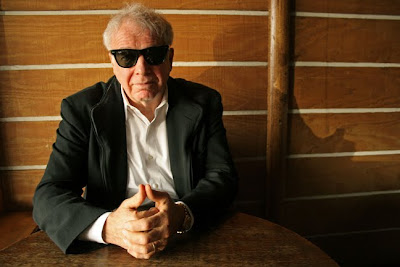
Thompson in 2010.
(interviewed by Matt Endahl on December 26th, 2011)